
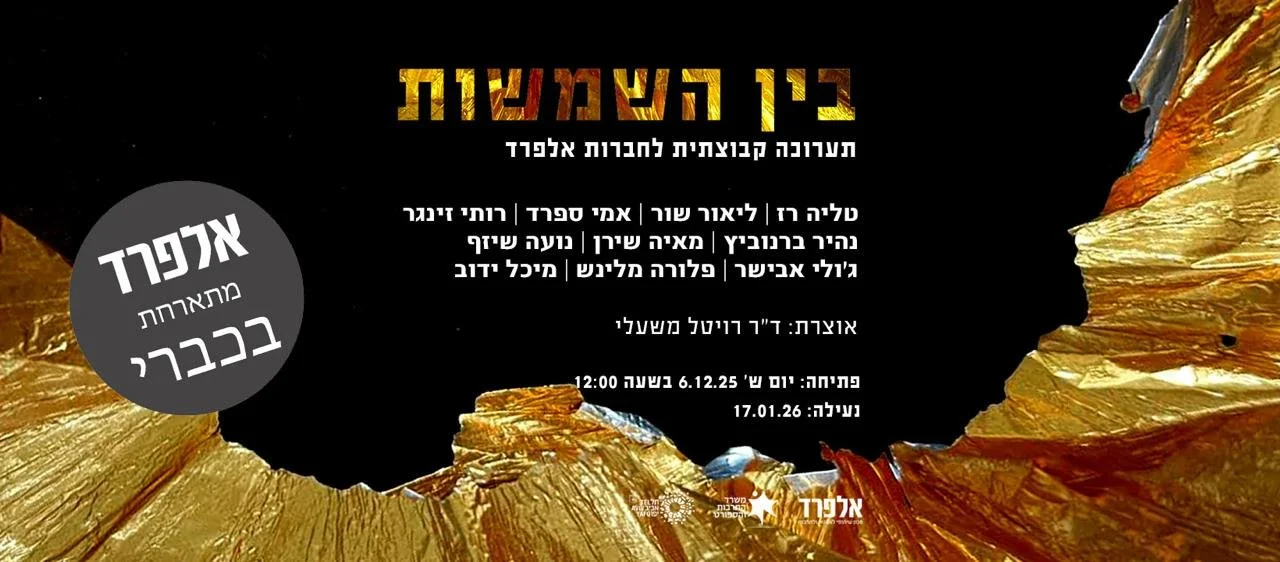
Between Night and Day
Alfred Gallery Presenting at Cabri Gallery
Talya Raz | Lior Schur | Emi Sfard | Ruti Singer | Nahir Baranovitz | Maia Shiran |
Noa Sheizaf | Julie Avisar | Flora Malinash | Michal Yedvab
Curator: Dr. Revital Michali
6.12.25-17.1.26
Two years ago, the group exhibition Between Night and Day was shown at Alfred Gallery. Those were turbulent days, marked by the struggle against the judicial overhaul, the move into a new exhibition space in the Kiriyat Hamelacha district, and a significant shift in the gallery’s membership. A sense of promise was in the air, just before everything changed, just before October 7. Now, after onerous days of loss, injury, fracture, and endless pain, with a glimpse of the way to healing on the horizon, we are presenting our exhibition once again, this time at the Cabri Gallery, with a somewhat different constellation of Alfred gallery members.
Then, as now, we hoped the exhibition might open a gateway into another potential space, one in which all the possibilities we imagine for others and for ourselves could take shape.
It is a threshold we must cross in our struggle to restore meaning and the touchstones that were lost. To heal, we must allow ourselves to dwell in spaces of not-knowing. We must be willing to encounter loss, to compromise, to change, to brush against the edges, so that we may begin to imagine a new world.
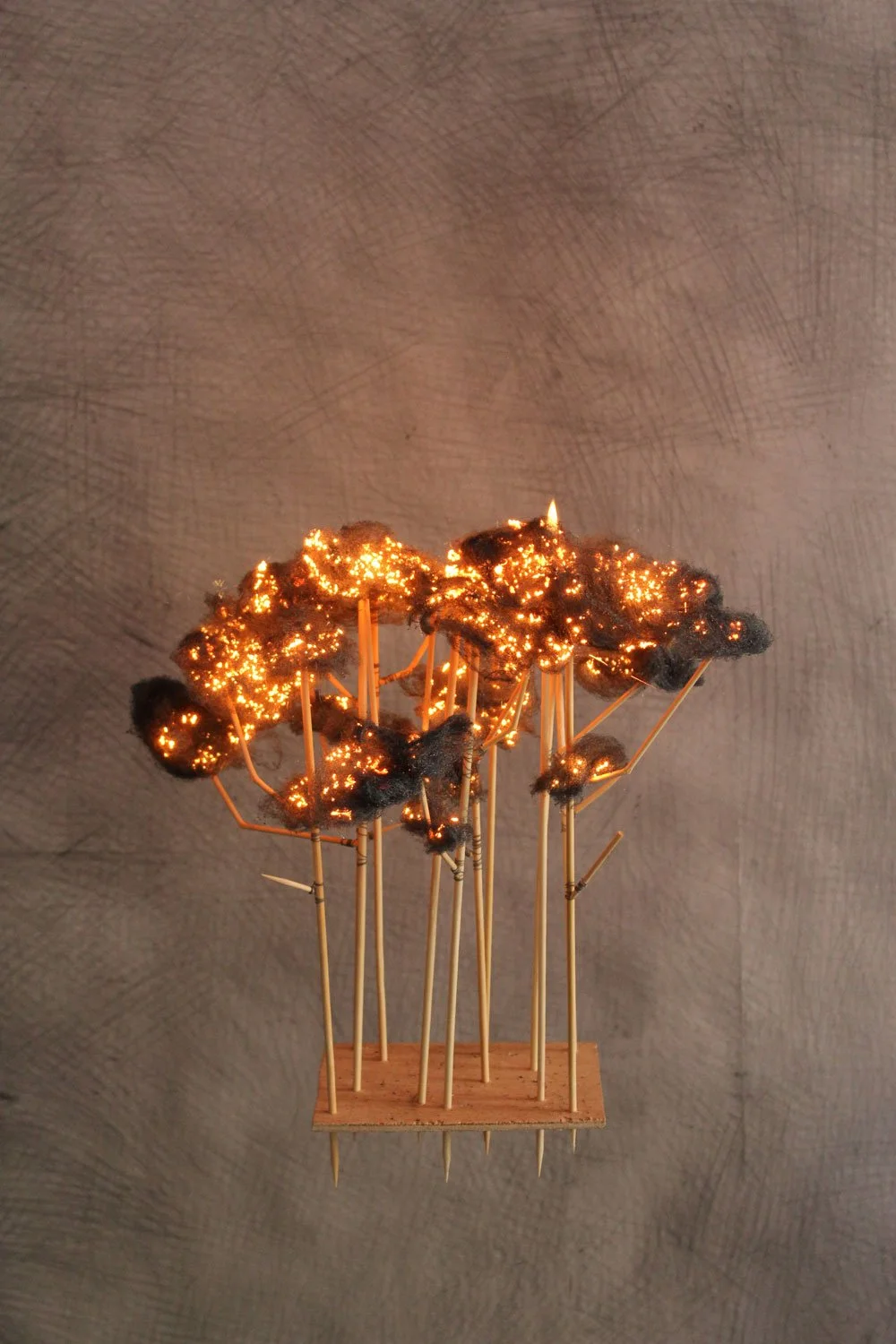
In one of the rabbinic texts, a particular moment is described occurring between day and night, between one orb and the other. The moment of bein hashmashot (“between day and night”) is a unique metaphorical threshold in which elements and opposites coexist side by side. It is portrayed as a miraculous time of friendship and unity, of transformation and change, of creation born out of urgency, just before the end. The works in this exhibition engage with the space of bein hashmashot across material, meta-poetic, symbolic, and psychological dimensions. The artists explore and construct zones of transition and inversion of reality. In their works, light emerges from darkness, white dissolves into black, the sea encroaches upon the land, wings break free from a cocoon, the forest turns to ash, a voice fades into silence then re-emerges, an image dissolves in motion, and falling becomes a gesture of forgiveness.
In their diverse works, the artists strive to create spaces able to retain paradoxes with quiet composure. Good and evil trade places, the image dissolves into a blot, logic transforms into ill-logic, the vessel reverts to its raw material, and the finished work reveals itself as a sketch. Within these transitional zones, cracks and traces of crisis, separation, illness, and loss emerge. Yet, like the gemstones embedded among the works, seeds of hope shimmer within a landscape of destruction and ruin — promises of renewal, dialogue, and the option to create.
Outside the gallery stands Emi Sfard’s video installation Once Upon A Time, a transformative threshold between realms and stages of life. The symbolic forest is in fact the Ben Shemen Forest, which for Sfard embodies a personal journey of maturation and disillusionment. Once an enchanted and beautiful landscape where joyful family events were held during the artist’s childhood, in adulthood the forest is revealed as a site that conceals dispossession and the erasure of Palestinian villages and lives now buried beneath it.
In Recalibration and Landing Strip, placed alongside Sfard, Nahir Baranovitz grapples with questions of imbalance, extremity, and the loss of national direction. The works, created in response to the events of October 7 and the war that followed, serve as the artist’s call to recalibrate our moral compass as a society, to discover restraint and balance, and not to surrender to feelings of rage and revenge.
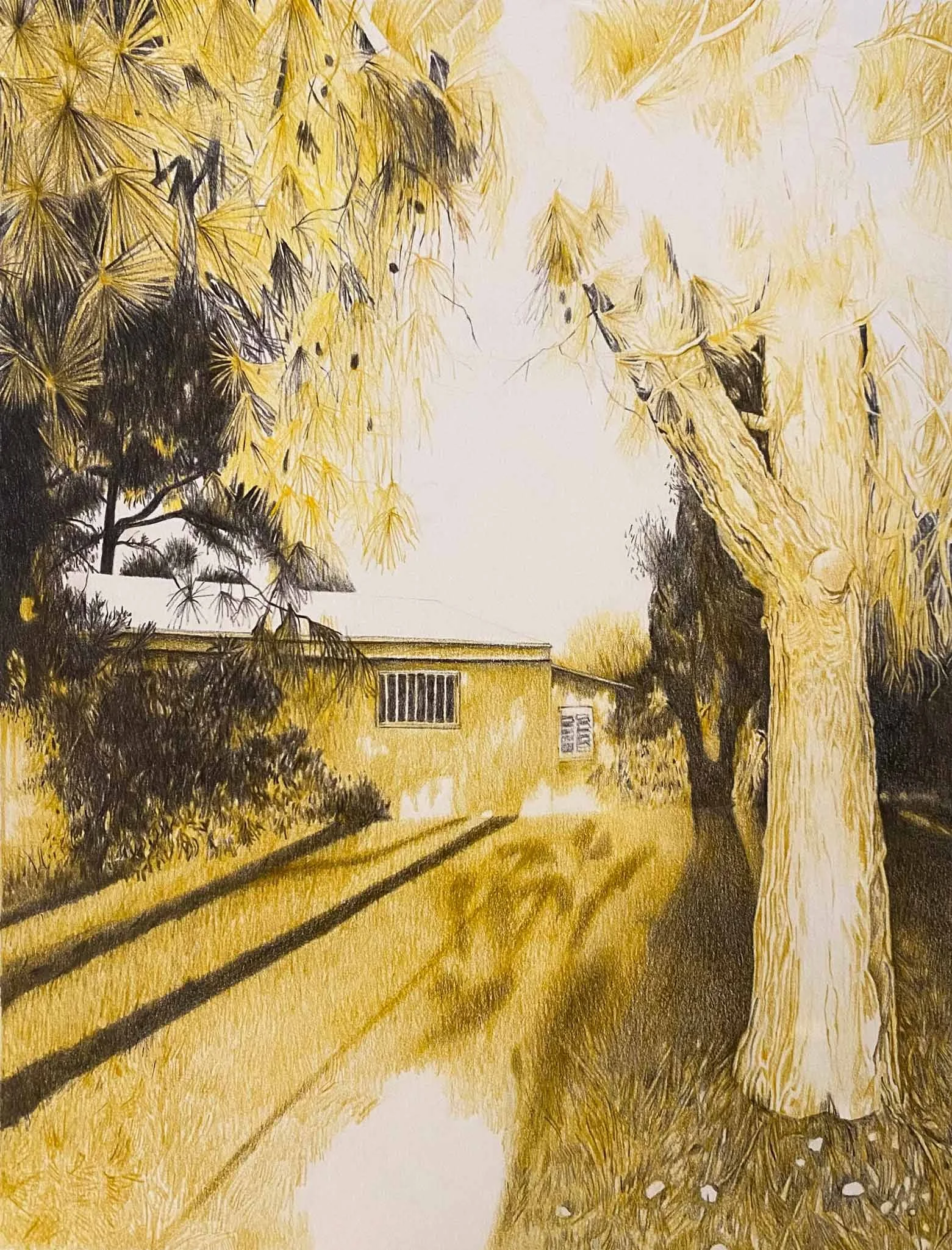
At the entrance to the gallery, three color drawings by Julie Avisar capture a nocturnal landscape in an unresolved state—at once intimate and anonymous. Avisar explores the relationships between source and negative, between flora and the inanimate: light fades into darkness, and darkness transforms into a blinding and white that erases. The vegetation and trees seem almost alive, breathing, while the structures at the edge of the frame evoke distance, silence, and mystery. A liminal space emerges—not day and not night, not familiar and not alien — a time of waking dream.
In Michal Yedvab’s collage works The Invisible City 1 and 2, an urban space is dismantled and reconstructed, layered and compressed without clear hierarchy, producing a sense of instability and chaos. The first work is a photographic collage reconstructing reality, while in the second, the connection is created through the act of drawing. Her use of charcoal emphasizes the transience of the material, always at risk of erasure and disappearance, between disintegration and becoming. The works invite the viewer to linger in density and ambiguity, between light and shadow, between strong and fragmented, between revealed and concealed—and within this, to find solace in the unexpected wholeness that emerges.
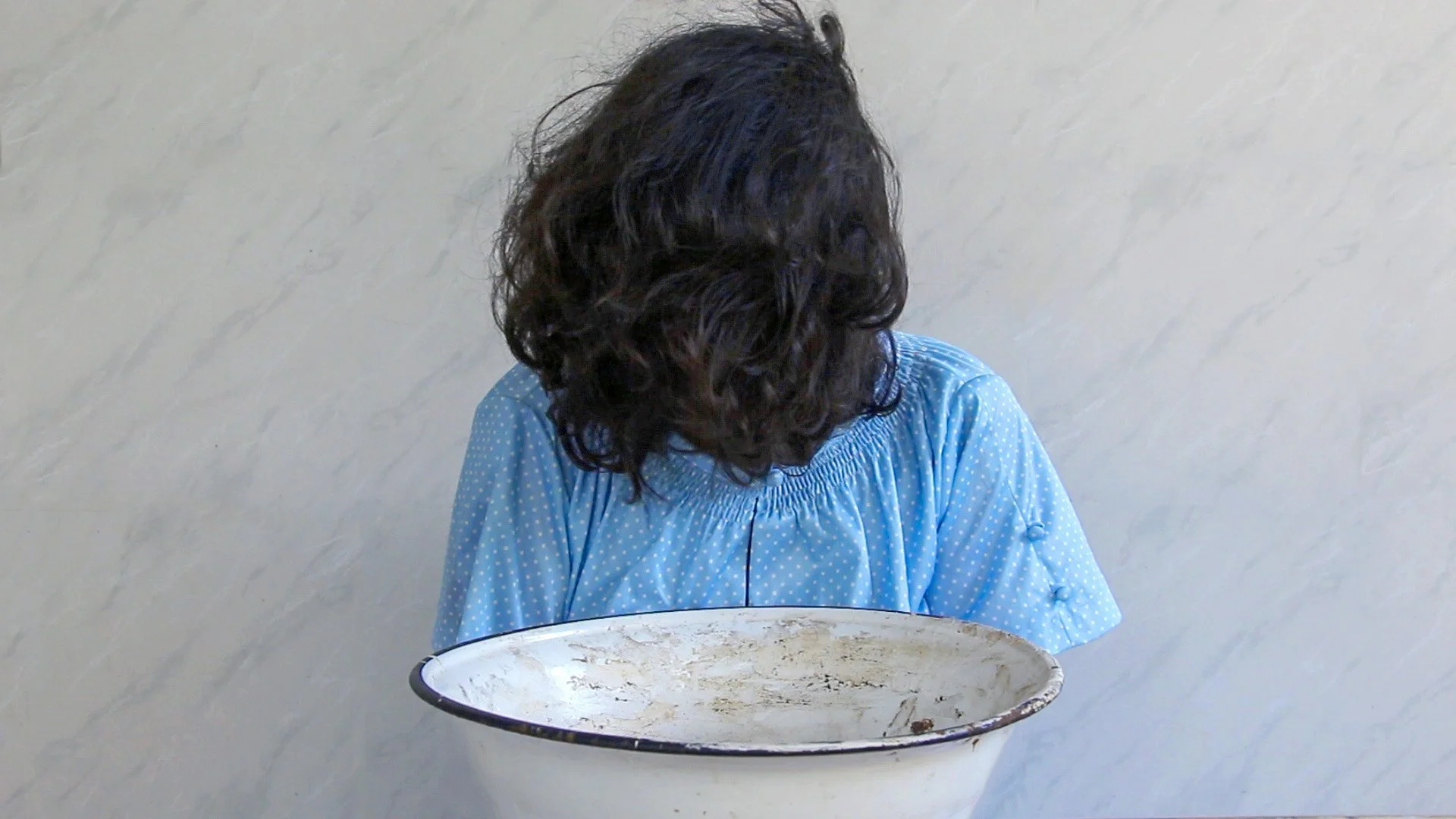
The three series presented by photographer Flora Malinash deal directly with fences and unruly boundaries. Malinash wanders through her childhood neighborhood, capturing objects and spaces that function differently in a new context. Artificial elements merge into natural surroundings: a carpet rests on a sandy surface, an iron fence blends into a hedge, and synthetic grass spreads across soft earth and natural elements. The artist’s engagement with boundaries takes on a meta-poetic and autobiographical tone. Malinash photographs herself without revealing her identity. With her back to the camera, her face hidden beneath her hair, her hands, or large leaves, she is present bodily in the place familiar to her, yet her subjective identity is absent as she becomes one with her environment.
Talya Raz’s plaster objects contain tension between the underwater world and the world of land, between living and inanimate, between energies of decline and disappearance and forces of revival and transformation. Raz casts hybrid objects in material, fusing body parts with shells, which appear as though taken from a world similar to ours yet distant from it. They convey a yearning for another world, where no decision must be made and where one can live both ways simultaneously.
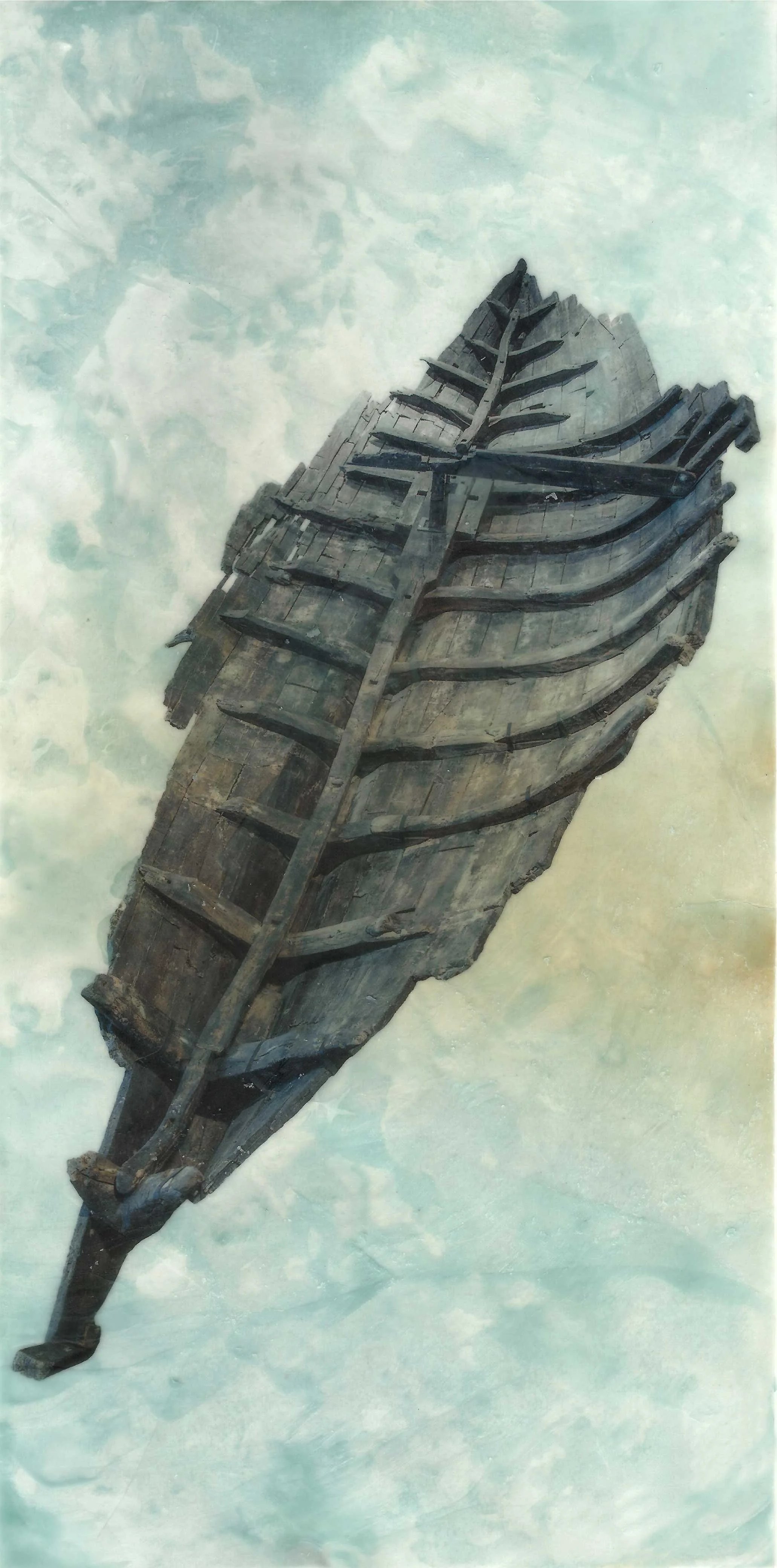
The three sketches (spaceships) presented by Noa Sheizaf, made for large paper ship installations exhibited in the past, resonate between sea and land, nature and culture, past and present, destruction and renewal. Sheizaf coats in wax photographs of ancient ships that sank in the Mediterranean Sea, were discovered by archaeologists, retrieved from the water after underwater excavation, and underwent a long and complex preservation process, ultimately becoming museum exhibits. In this way, the artist calls attention to the arduous work of rescue and preservation, pointing to the act of transforming the ship into something eternal.
In Maia Shiran’s works, repetition is evident as a mechanism for coping with feelings of estrangement. The abstract works preserve a raw state of potential between line and image, between blot and form, maintaining a repetitive movement of motif or recurring pattern (in print). Yet the repetition is never identical; change is evident from image to image and from action to action. Thus, contradictory sensations of fixation and movement arise, stirring anticipation.
The monochromatic ceramic works are part of an ongoing series titled The Sun Has Never Seen the Moon’s Blemish, created by Lior Schur especially for the exhibition. The hand-formed and non-functional vessels are dedicated to elements that were created at twilight. When creating the vessels, Schur deliberately works so quickly that the material collapses into itself; in the drawings on the vessels, as well as on the plates in the exhibition, are in sgraffito technique, where images are carved out of a dark background. Thus the object itself is born from a struggle between destruction and construction, between potential and embodiment. In addition, Schur presents ceremonial stone-like objects, which she calls “bridal stones” (or pyrite; fool’s gold). These continue the ongoing quest for the alchemical, spitirual, and material that characterizes her work.
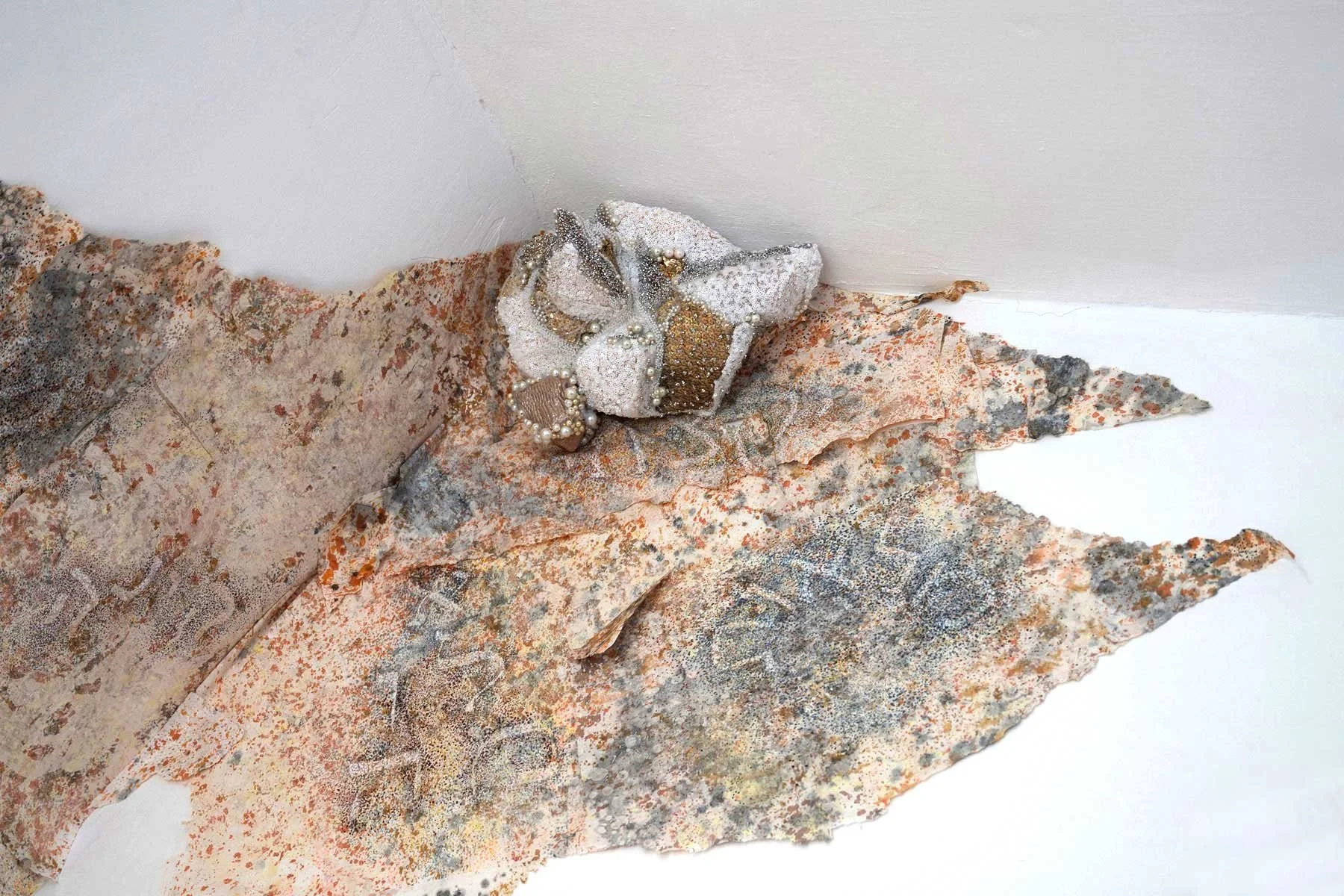
Ruti Singer’s work But a Speck examines the gap between what is visible to the eye and understood by consciousness, and hidden, subconscious layers and stratae. Singer painstakingly paints tens of thousands of dots, like an ant moving through a space multitudes larger than itself. She builds a large surface that from afar may seem like a topographic or astronomical map, aspiring to take over the entire space. A sequence of words drawn on transparent sheets are visible through the glass gallery doors that close or open the exhibition. When the gallery lights are turned on, the piercing words are reflected on the floor like a flickering light at the end of a tunnel.
— R.M.
About the curator
Dr. Revital Michali is a researcher, independent art curator, dramaturgist and performance artist living and working in Tel Aviv-Jaffa. Michali holds a Ph.D. in Visual Arts from Tel Aviv University. Her writing and artistic practice focus on female identity, motherhood, and their connection to public spaces. She has curated and produced art exhibitions and events in Tel Aviv, Berlin, and the USA.
Member of the Alfred Institute for Art and Culture since 2021.